How to play chess: rules, moves and how to win
Updated · 4 min read
Chess is the oldest strategy game most people know by name, and its rules have barely changed in five hundred years. Two players, sixteen pieces each, and one goal: trap the other king. The rules take an afternoon to learn and a lifetime to master. This guide covers them all, including the special moves beginners often miss, plus how our version handles clocks, draws and take-backs.
What you need and the goal
Two players, a board of 64 squares in 8 rows and 8 columns, and two sets of sixteen pieces, one white and one black. Each side has a king, a queen, two rooks, two bishops, two knights and eight pawns. The goal is checkmate: attacking the opponent's king so that it has no way to escape.
Setup
Place the board so each player has a light square in the bottom right corner. On your back row, from the corners in: rooks, then knights, then bishops. The queen goes on the remaining square of her own color (the white queen on a light square, the black queen on a dark one), and the king goes beside her. Your eight pawns fill the row in front. White always moves first, and then players alternate, one move each.
How the pieces move
- King: one square in any direction. It may never move onto a square where it would be attacked.
- Queen: any number of squares in a straight line, along rows, columns or diagonals.
- Rook: any number of squares along a row or column.
- Bishop: any number of squares diagonally, so it always stays on its starting color.
- Knight: in an L shape, two squares one way and one square to the side. It is the only piece that jumps over others.
- Pawn: one square straight forward, or two on its very first move. It captures one square diagonally forward, not straight ahead.
Apart from the knight, no piece can pass through another. You capture by moving onto a square occupied by an opponent's piece, which is removed from the board. You may never capture your own pieces.
Check, checkmate and the special moves
A king under attack is in check. You must get out of check at once, by moving the king, blocking the attack, or capturing the attacking piece. If none of those is possible, it is checkmate and the game is over. You may never make a move that leaves your own king in check.
- Castling: once per game, the king moves two squares toward a rook and that rook jumps to the square on the king's other side. Neither piece may have moved yet, the squares between them must be empty, and the king may not be in check, pass through an attacked square, or land in check.
- En passant: if a pawn moves two squares and lands right beside an enemy pawn, that enemy pawn may capture it as if it had moved only one square. It must do so immediately or lose the chance.
- Promotion: a pawn that reaches the far row becomes a queen, rook, bishop or knight of its player's choice. Almost everyone chooses a queen.
How a game ends
A game is won by checkmate, by the opponent resigning, or on time if a clock is used. A game is drawn by:
- Stalemate: the player to move is not in check but has no legal move.
- Repetition: the same position occurs three times.
- The fifty-move rule: fifty moves by each player with no capture and no pawn move.
- Insufficient material: neither side has enough pieces left to checkmate, such as king against king.
- Agreement: one player offers a draw and the other accepts.
Common house rules and variations
- Touch-move: if you touch a piece, you must move it. Strict at clubs, often ignored at home.
- Take-backs: casual games often allow undoing a blunder. Clubs never do.
- Fast time controls: blitz games give each player a few minutes for the whole game, sometimes with a few seconds added after each move.
- Odds games: a stronger player starts without a piece to even out the game.
How chess plays on Knockout
Our Chess plays the full standard rules, including castling, en passant, promotion with a choice of piece, and every draw above. From the game's own settings:
- No clock by default. The host can pick 5, 10 or 15 minutes per side, 3 minutes plus 2 seconds a move, or 15 plus 10. Clocks run only on your turn, and if a clock runs out against a player who cannot possibly checkmate, the game is a draw.
- Against the computer (Easy, Normal or Hard) and without a clock, Take back undoes your last move and the computer's reply. The host can turn take-backs off.
- A draw offer stands until your opponent answers or makes their move.
- After the game, step through every move or copy it as PGN, the standard notation other chess programs read. A new chess puzzle is posted every day at Chess Puzzles.
Beginner tips
- Control the center. Pawns and pieces on the middle four squares give you room and limit your opponent.
- Develop your knights and bishops early, before moving the same piece twice.
- Castle in the first ten moves or so. It tucks your king away and brings a rook into play.
- Before every move, ask what your opponent's last move threatens. Most beginner games are lost to a piece left hanging.
Where to play chess free
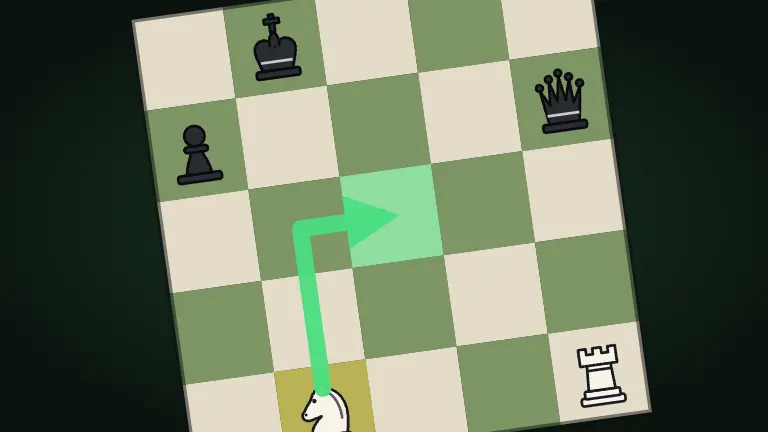
Chess is free in a browser here. Playing the computer needs no account: open it and pick Easy, Normal or Hard. To play a friend, make a free player (a username and a PIN or password), create a game and send the link. Chess Puzzles is a solo puzzle with no sign-up at all.
For a simpler game on the same board, read How to play checkers: rules, jumping and kings. For a race game with dice and more luck, read How to play backgammon: rules, moves and scoring, and see more in The best 2-player games to play online.