How to play baccarat: rules, the third card and payouts
Updated · 6 min read
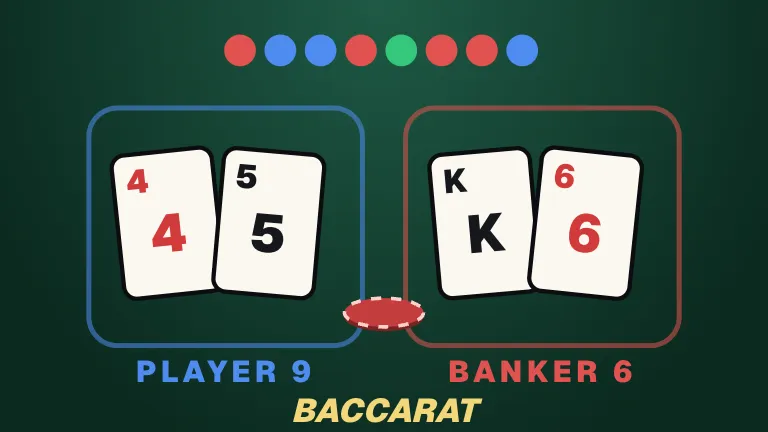
Baccarat looks formal from across a room, but it may be the easiest casino card game there is. Two hands are dealt, one called Player and one called Banker, and you bet on which will end closer to 9. Nobody at the table makes a decision once the cards are out: fixed rules say when each hand takes a third card. That makes the bet the whole game. This guide covers the standard version, often called punto banco, the payouts and the common house variations, and how our free table works. Nothing here is real money: chips cannot be bought, sold or cashed out.
What you need and the goal
- A shoe of several standard decks shuffled together. Casinos usually use eight; at home, any number works.
- Aces count 1. Two to nine count their number. Tens, jacks, queens and kings count 0.
- Chips, and a layout with three main places to bet: Player, Banker and Tie.
A hand's total is the sum of its cards with the tens digit dropped. A 7 and an 8 make 15, which counts as 5. A 9 and a king make 9. Two picture cards make 0, sometimes called baccarat, the worst total and the game's namesake. No hand can go over 9, so there is no busting.
The names Player and Banker are just labels. You do not have to bet on the Player hand because you are a player, and the Banker hand is not the house. Everyone at the table picks a side, or the tie, and the house pays whoever is right.
Betting and the deal
Every player places a bet before the deal, within the table's limits. Most tables allow a bet on Player or on Banker, plus an optional bet on a Tie. Many also offer small side bets such as the pairs, described below.
The dealer then deals four cards face up, alternating: one to Player, one to Banker, a second to Player and a second to Banker. If either hand totals 8 or 9 with its first two cards, that is a natural. Both hands stand, and the higher total wins at once.
The third-card rules
Without a natural, each hand may take one more card, and only one. The rules are fixed, so the dealer applies them for everyone. Player goes first:
- Player with 0 to 5 draws a third card.
- Player with 6 or 7 stands.
If Player stood, Banker follows the same simple rule: draw on 0 to 5, stand on 6 or 7. If Player drew, Banker's choice depends on its own total and on the value of Player's third card:
- Banker with 0, 1 or 2 always draws.
- Banker with 3 draws unless Player's third card was an 8.
- Banker with 4 draws when Player's third card was 2 to 7.
- Banker with 5 draws when Player's third card was 4 to 7.
- Banker with 6 draws when Player's third card was 6 or 7.
- Banker with 7 stands.
This table is where newcomers get lost, and it is worth knowing that you never need to memorize it to play. It matters only for following the action, and for understanding why Banker wins slightly more often than Player: Banker acts second, with information about Player's draw.
Payouts and the commission
- Player wins: paid even money, 1 to 1.
- Banker wins: paid 1 to 1, minus a 5% commission on the win. A 100 bet wins 95.
- Tie: paid 8 to 1 at most tables. If the hands tie, bets on Player and on Banker are returned, neither won nor lost.
- A losing bet goes to the house.
The commission exists because Banker wins a little more often. Without it the Banker bet would beat the house. Even with the commission, Banker is the best bet on a standard table: the house keeps about 1.06% of what is bet there, against about 1.24% on Player. The Tie looks tempting at 8 to 1 but costs about 14%, more than ten times as much.
Common house rules and variations
- No-commission tables: Banker pays even money, except a Banker win with a total of 6, which pays only half. That shifts the edge, and Player becomes the slightly better bet.
- Tie payouts: a few tables pay 9 to 1 on a tie, which cuts its cost a lot. Most pay 8 to 1.
- Pair bets: a side bet that Player's or Banker's first two cards are the same rank, a pair of kings or of sevens. It usually pays 11 to 1.
- The burn: when a new shoe starts, the dealer turns the first card face up and burns that many cards face down, with a ten or picture card counting 10.
- The cut card: a plastic card placed near the end of the shoe. When it comes out, the shoe is finished after that hand and reshuffled.
Many tables also keep score cards and boards of past results, the most common being a bead plate: a grid of colored circles, one for each hand, filled in column by column. These records are fun to read but predict nothing. Each deal is independent of the last.
How baccarat plays on Knockout
Our Baccarat seats one to five players at the same table, with the same felt, chips and stacks as our Blackjack table. From the game's own rules:
- Eight decks in the shoe. A new shoe burns cards by the rule above, and once the cut card, 16 cards from the end, has come out, the shoe is reshuffled before the next round.
- Bet on Player or Banker (not both), the Tie, Player Pair and Banker Pair, from 10 to 500 chips on each spot in steps of 10. Pick a chip, tap the spots on the felt, then press Bet. Your last bets are offered again next round.
- Payouts are exactly as above: Player 1 to 1, Banker 1 to 1 less 5% (rounded up to the whole chip, so a 10 bet wins 9), Tie 8 to 1 with Player and Banker bets returned on a tie, and either pair 11 to 1.
- The host picks 10, 20 (the default) or 30 rounds; 500, 1,000 (the default) or 2,500 starting chips; and a standard or a no-commission table.
- The cards turn one beat at a time and a bead plate of the shoe's results sits at the top of the felt. Tap the felt to skip straight to the result.
- After the last round, the player with the most chips wins. Playing alone, you win by finishing with more than you started with. Run out and you may rebuy a fresh stack once a game.
Beginner tips
- Bet Banker at a standard table and Player at a no-commission table. Each is the lower-cost bet there.
- Treat the Tie and the pairs as an occasional treat, not a habit. They pay big because they rarely land.
- Size bets so a run of losses can't empty your stack: a twentieth of your chips is a sensible start.
- Ignore streaks on the bead plate. The shoe has no memory.
Where to play baccarat free
Baccarat is free in a browser here with play chips. Playing alone or with computer players needs no account; computer players come at Easy, Normal and Hard, from hunch bets on ties and pairs to steady bets on the better side. To sit at a table with friends, make a free player (a username and a PIN or password), create a game and send the invite link or code. Knockout is for people 13 and older.
For a casino game where your choices change the odds, see How to play blackjack: rules, payouts and basic strategy. For one where you play the other players instead of the house, try How to play Texas hold'em: rules, hands and betting, and for a game of pure chance with more ways to bet, there is Roulette.