How to play euchre: rules, scoring and strategy
Updated · 5 min read
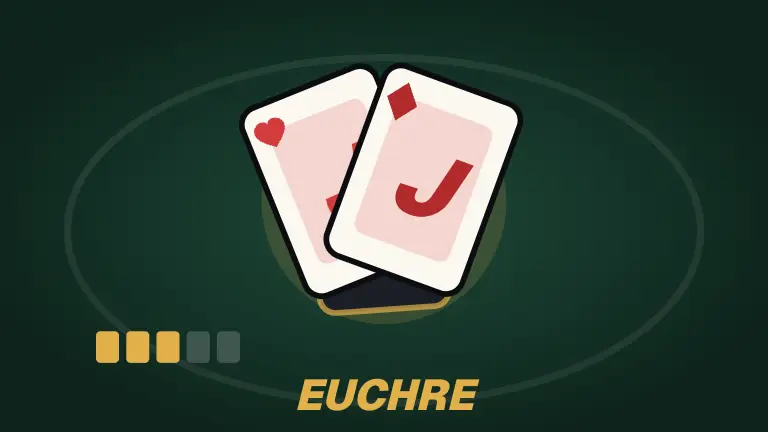
Euchre is a fast partnership card game for four people, played with a short deck and a strange little twist: two of the jacks become the best cards in the game. A hand takes a couple of minutes, the table talk never stops, and a full game to 10 points fits in a coffee break. This guide covers the rules as most tables play them, the house rules you will run into, and exactly how our version works.
What you need and the goal
- Four players in two teams. Partners sit across from each other, so the play goes around the table alternating between teams.
- A 24-card deck: the 9, 10, jack, queen, king and ace of each suit. Everything below the 9 stays in the box.
- Something to keep score. Many tables use two spare cards, a 4 and a 6, sliding one over the other to show points.
The goal is to be the first team to reach the target score, usually 10 points. You earn points by naming trump and then taking at least three of the five tricks, or by stopping the other team when they name trump and fall short.
Card ranks and the bowers
Once a trump suit is chosen, the jack of that suit becomes the highest card in the game. It is called the right bower. The second highest is the other jack of the same color, the left bower. If hearts are trump, the jack of hearts is the right bower and the jack of diamonds is the left bower, and for the rest of the hand that jack of diamonds counts as a heart in every way, including when you have to follow suit.
Below the two bowers, trump runs ace, king, queen, 10, 9. That makes seven trumps in all. The other three suits rank ace, king, queen, jack, 10, 9, except that the suit sharing a color with trump has lost its jack and has only five cards.
Setup and the deal
The dealer gives everyone five cards, traditionally in packets of two and three. The remaining four cards form the kitty, and the dealer turns the top one face up. That upcard is the first suggestion for trump.
Bidding happens in two rounds. In the first round, starting left of the dealer, each player may pass or order it up. Ordering up makes the upcard's suit trump. When that happens the dealer picks up the upcard, adds it to their hand and discards one card face down. If the dealer's partner orders it up, it still goes into the dealer's hand, which is why ordering up your own partner is called assisting.
If all four players pass, the upcard is turned face down and the second round begins. Each player, again starting left of the dealer, may name any other suit as trump or pass. The suit that was just turned down is off limits for this hand.
How a hand works
The team that named trump are the makers; the other team are the defenders. Before play starts, the player who named trump may choose to go alone. Their partner lays their cards face down and sits the hand out, and the lone player takes on both defenders.
The player left of the dealer leads the first trick, skipping anyone sitting out. Everyone must follow the suit that was led if they can. If you cannot follow, you may play any card, including trump. The highest trump wins the trick; if nobody played trump, the highest card of the suit led wins. The winner of each trick leads the next one, and after five tricks the hand is scored.
One trap catches every beginner: the left bower belongs to trump. If spades are trump and someone leads clubs, you cannot play the jack of clubs to follow suit, because it is a spade for this hand. And if a spade is led and the jack of clubs is your only trump, you must play it.
Scoring
- The makers take three or four tricks: 1 point.
- The makers take all five tricks, called a march: 2 points.
- A player who went alone and takes all five tricks: 4 points.
- The makers take fewer than three tricks: they are euchred, and the defenders score 2 points.
The deal passes to the left after every hand, and the first team to the target wins.
Common house rules
- Stick the dealer: if everyone passes twice, the dealer must name a suit instead of throwing the hand in. It speeds the game up and keeps the dealer honest.
- Game length: some tables play to 5 for a quick game, others to 11.
- Defending alone: a few tables let a defender go alone against the makers for a 4-point euchre.
- Farmer's hand: a player dealt only 9s and 10s may swap them for the kitty in some groups.
- The joker or benny: an extra card added as the highest trump of all, common in some regions.
How euchre plays on Knockout
Our Euchre follows the standard rules above, with these specifics, taken straight from how the game is built:
- Stick the dealer is on by default. The host can switch it off, and then if all four pass twice the hand is thrown in and the deal moves left.
- The host picks the target: 5, 10 (the default) or 11 points. A turn clock is optional; when it runs out, a sensible move is made for you.
- Going alone is open to whoever names trump. If the dealer's partner orders it up alone, the dealer sits out and the upcard stays in the kitty.
- There is no defending alone, no farmer's hand and no joker: a euchre is always worth 2 to the defenders.
Beginner tips
- Count your trumps before you order. Three trumps, or two with a bower and an off-suit ace, is usually enough to make it.
- Think twice before ordering up when you are not the dealer's partner: you are handing the dealer an extra trump.
- Lead trump when your team called it and you hold the right bower. Pulling the defenders' trumps protects your partner's aces.
- As a defender, lead an ace in a side suit early, before the makers can trump it.
- Do not take your partner's winning trick with a trump. Save it for a trick you would otherwise lose.
Where to play euchre free
You can play Euchre free in a browser here. Against the computer there is nothing to sign up for: open the game and computer players take the other three seats, at Easy, Normal or Hard. To play with friends, make a free player (a username and a PIN or password), create a game and send the invite link or code. Empty seats can still go to computer players, so two friends can team up against a pair of bots.
If you like euchre, the other partnership trick-takers are close cousins: Spades swaps the bowers for bidding, and Pinochle adds melds to the tricks. Read How to play spades: rules, bidding and scoring next, or see every table game in Free card games online: classics, partners and party decks.