How to play FreeCell: rules, free cells and strategy
Updated · 4 min read
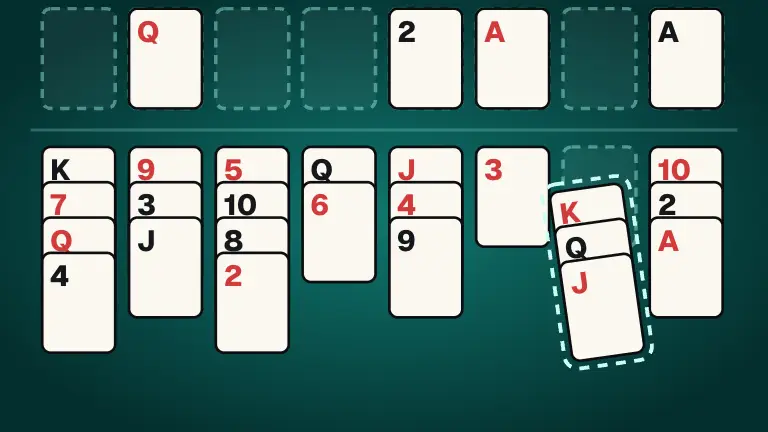
FreeCell is solitaire for people who like puzzles. Every card is dealt face up from the start, so nothing is hidden and luck plays almost no part: if you lose a deal, there was nearly always a way through. Four small holding spaces, the free cells, give you just enough room to dig for the card you need. Here are the rules, the variations, and how our version works.
What you need and the goal
One player and one standard 52-card deck. The goal is to move every card onto four foundation piles, one per suit, each built up from ace to king. Unlike most solitaires, almost every FreeCell deal can be won with careful play.
Setup: the layout
Deal all 52 cards face up into eight columns, left to right. The first four columns get seven cards each and the last four get six. Above the columns sit two rows of four spaces: on one side the four free cells, on the other the four foundations. Everything starts empty except the columns. There is no stock and no waste pile: every card you will ever play is on the table already.
How play works
- Columns: you may move the bottom card of any column onto another column's bottom card if it is one rank lower and the opposite color. A red 9 goes on a black 10.
- Free cells: any single card can be parked in an empty free cell. Each cell holds one card, and a card in a cell can later move to a column or a foundation.
- Empty columns: any card, or any properly built run, can fill an empty column. An empty column is worth more than a free cell.
- Foundations: aces start the foundations, then each suit builds up in order to the king.
Moving runs: the supermove
Strictly, only one card moves at a time. But if you have free space, you can move a whole run, such as black 10, red 9, black 8, one card at a time through the empty cells and columns, and most versions let you drag it in one go. The longest run you can move is the number of empty free cells plus one, doubled for each empty column. With two free cells empty and one empty column, that is (2 + 1) x 2 = 6 cards. If you are moving the run into the empty column itself, that column does not count.
Numbered deals and winning
FreeCell deals are traditionally numbered, so the same number always produces the same layout and players can compare notes on a famous deal. Among the first 32,000 classic deals, only one is known to be unwinnable: number 11,982. Almost every other deal can be won, which is why FreeCell scoring is usually just a win rate and a streak rather than points.
Common house rules and variations
- Fewer free cells: playing with three, two or even one cell makes the game much harder.
- Single-card moves only: purists move every card individually instead of dragging runs.
- No undo: a stricter way to play, where every move is final.
- Baker's game: a cousin where runs are built by suit instead of alternating colors.
How FreeCell plays on Knockout
Our FreeCell uses the standard rules and four free cells. From the game's own code:
- Deals are numbered 1 to 1,000,000 with the classic numbering, so deal 1 here is the same deal 1 you may know. Random deals skip 11,982 and the handful of others like it.
- You can drag a whole run in one go, and the game does the card-by-card shuffling for you. The Carry number above the table shows how long a run you can move right now.
- The Daily Deal is one numbered deal a day, the same for everyone, checked by the solver first. Practice deals are endless, or you can pick one by number.
- Undo is unlimited. Hint asks the solver for a move that still leads to a win. Cards nothing needs go up to the foundations by themselves (you can turn that off), and once every column is in order the game finishes itself.
FreeCell is also one of the three modes inside our Solitaire, alongside Klondike and Spider.
Beginner tips
- Find the aces and 2s first. Plan how to free them before making your first move.
- Use free cells sparingly. Every card you park is space you no longer have, and a full set of cells is how most deals are lost.
- Work toward an empty column. It doubles how far you can move a run and is the strongest position on the table.
- Look a few moves ahead before parking a card. Ask where it will go next, not just where it can go now.
- Do not hurry cards to the foundations when they are still useful. A red 4 left on a column may be the only place a black 3 can go while you dig for something else.
Where to play FreeCell free
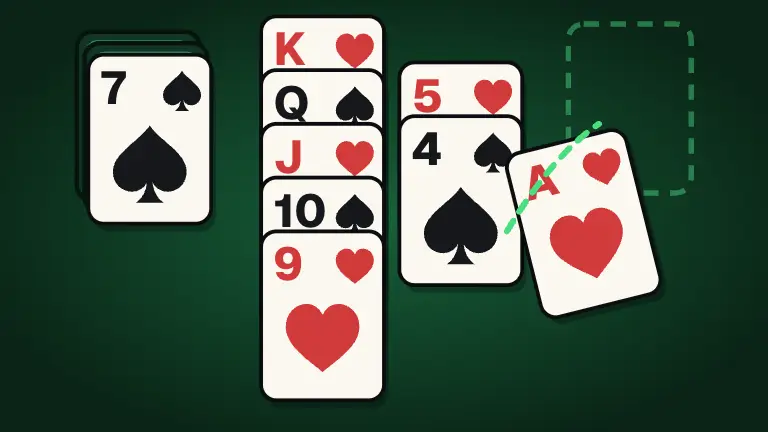
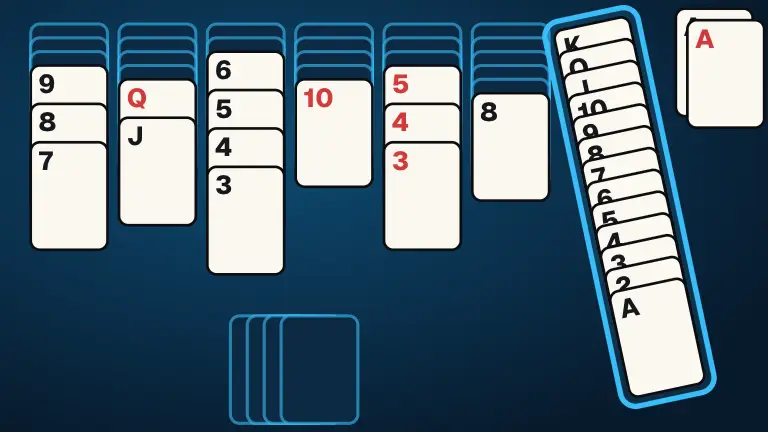
FreeCell is free in a browser here, with no account and no sign-up. It is a solo game, with no computer players or friends to invite, and your stats and daily streak are kept on your device.
For the classic version with hidden cards and a stock, read How to play solitaire (Klondike): rules and scoring. For a two-deck challenge, read How to play Spider Solitaire: rules for 1, 2 and 4 suits. And if you like a solvable daily puzzle, Mahjong Tiles is the same kind of calm planning, with tiles instead of cards. All our solitaires are compared in Free online solitaire: which one to play and how to win.