How to play Spider Solitaire: rules for 1, 2 and 4 suits
Updated · 4 min read
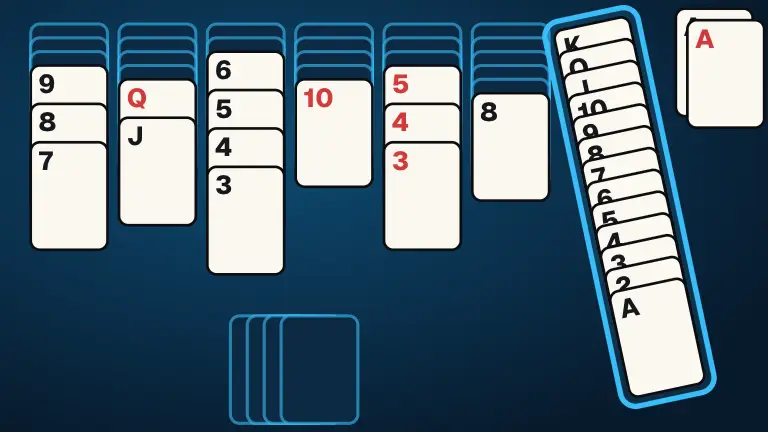
Spider Solitaire is the big, slow-burning cousin of classic solitaire: two decks, ten columns, and a goal of sorting everything into complete runs. With one suit it is relaxing; with four suits it is one of the hardest solitaires around. This guide covers the rules, the difficulty levels, the usual variations, and how our version plays.
What you need and the goal
One player and two standard decks, 104 cards in all. The goal is to clear the table by building eight complete runs, each going from king down to ace in a single suit. A finished run is removed from play, and when all eight are gone, you have won.
- One suit: all 104 cards are spades. The gentlest version and a good place to learn.
- Two suits: spades and hearts. A real puzzle that still wins often.
- Four suits: the full two decks. Hard, and many deals are lost even with good play.
Setup: the layout
Deal 54 cards into ten columns. The first four columns get six cards each and the other six get five. Only the top card of each column is face up. The remaining 50 cards stay face down as the stock, to be dealt out later in five rows of ten.
How play works
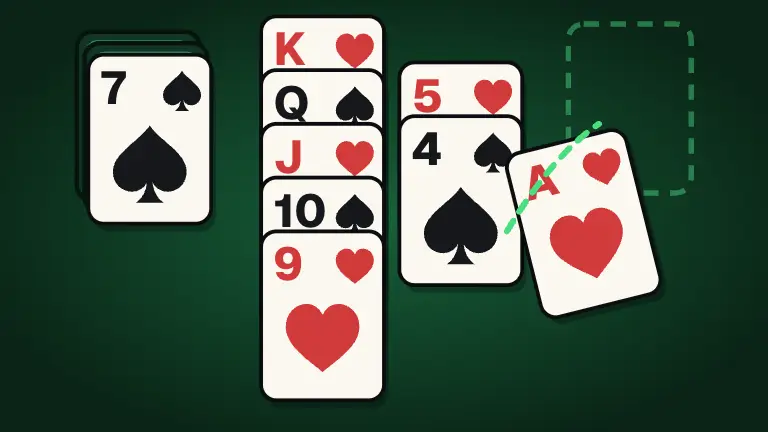
- Building: you may place any card on a card one rank higher, regardless of suit. A red 6 on a black 7 is a legal move.
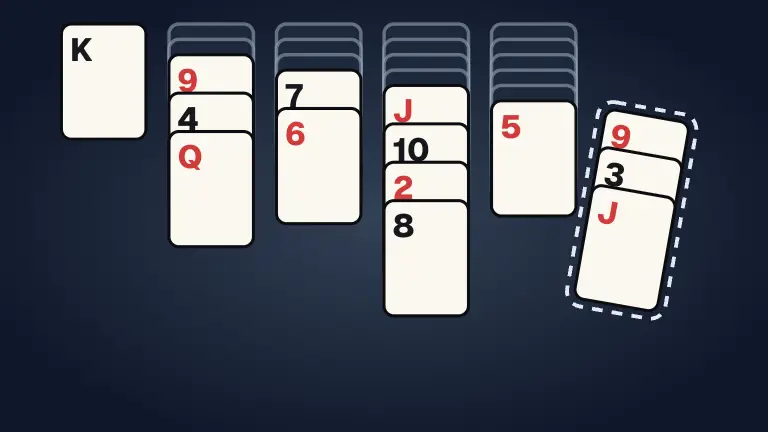
- Moving runs: only a run in the same suit, in order, can move together as one piece. A mixed-suit stack has to be taken apart card by card.
- Turning cards: when a face-down card is uncovered, turn it face up.
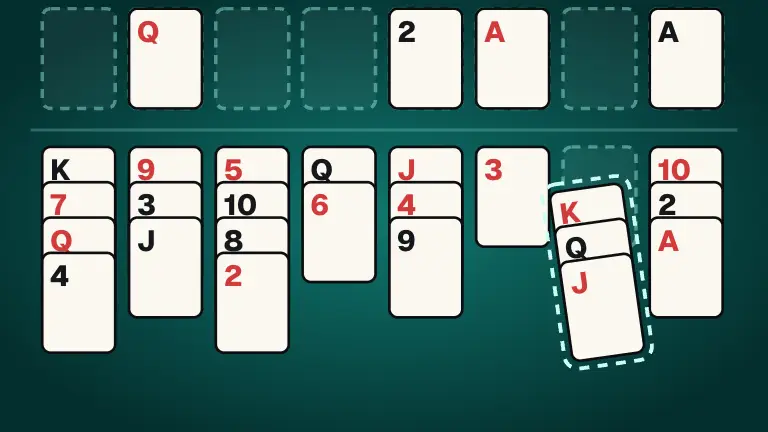
- Empty columns: any card or same-suit run can go into an empty column.
- Completing runs: when a column holds a full king-to-ace run in one suit, it is cleared off the table.
When you are out of useful moves, deal from the stock: one card face up onto every column. You may only deal when no column is empty, so fill every gap first. There are five deals in the stock, and each one buries cards you may have been trying to reach, so it pays to make every useful move before dealing.
Which suit count to play
The number of suits changes the game more than any other choice. With one suit every card fits on every other card one rank higher, and every run you build can move as a group, so the challenge is mostly about managing the stock deals. Most one-suit deals can be won by a careful player.
With two suits, half your builds will be mixed, and mixed runs cannot move together. You start to spend moves untangling spades from hearts, and empty columns become precious. With four suits the problem gets much worse: the cards you need are scattered across ten columns, and a single bad stock deal can bury the last card you were waiting for. A four-suit win is something to be proud of. A sensible path is to win a few one-suit games, then move up once you notice yourself planning several moves ahead.
Scoring
The usual score starts at 500 points. Every move costs one point, and every completed run earns 100. A quick, clean win scores highest. Many players ignore points and simply track how often they win at each suit count.
Common house rules and variations
- Undo or no undo: unlimited undo turns four suits from brutal to merely hard.
- Dealing with empty columns: a looser rule lets you deal even with gaps on the table.
- Spiderette: a one-deck cousin with seven columns, laid out like classic solitaire.
- Winnable deals only: some versions check each deal can be won before you play it.
How Spider plays on Knockout
Our Spider Solitaire plays the standard rules above at one, two or four suits. From the game's own code:
- One suit is all spades; two suits are spades and hearts; four suits is the full two decks.
- You can only deal from the stock when no column is empty. Scoring starts at 500, loses one per move (an undo counts as a move) and gains 100 per completed run.
- There is one Daily Deal each day for each suit count, the same for everyone. The one- and two-suit dailies have been checked by a solver and can be won; the four-suit daily is a straight shuffle, so most can be won but there is no promise.
- One- and two-suit practice deals are solver-checked too, unless you switch that off. Undo is unlimited, and Hint follows the solver when it can see a win.
Spider is also one of the three modes in our Solitaire, next to Klondike and FreeCell.
Beginner tips
- Start with one suit. Learn how the stock deals bury cards before adding the extra suits.
- Prefer same-suit builds. A 6 of spades on a 7 of spades can move later; a 6 of hearts on it cannot move as a group.
- Empty a column as early as you can. It is the most useful space on the table, for rearranging runs and digging out buried cards.
- Uncover face-down cards before dealing. Each deal puts a new card on every column, so finish your work first.
Where to play Spider free
Spider Solitaire is free in a browser here, with no account and no sign-up. It is a solo game, with no computer players or friends to invite, and each suit count keeps its own stats on your device.
For the one-deck classic, read How to play solitaire (Klondike): rules and scoring. For a solitaire where every card is face up and almost every deal can be won, read How to play FreeCell: rules, free cells and strategy. Yukon Solitaire and the rest are compared in Free online solitaire: which one to play and how to win.