Daily word and logic puzzles worth keeping a streak for
Updated · 4 min read
A daily puzzle is a small, good habit. It takes five minutes, it is the same for everyone, so you can compare notes, and it gives your brain something to chew on before the day gets busy. Here are the dailies worth adding to your routine, grouped by the kind of thinking they ask for.
How the dailies work
- A new puzzle every day, the same for everyone. The day turns over at midnight US Central time.
- Streaks count the days in a row you finish, and your stats keep games played and wins in each game's Stats.
- The Daily tab lists every daily puzzle in one place: what you have finished today, your streaks, and how your friends did.
- Most dailies also have a practice or free-play mode, so you can keep going after the day's puzzle.
Word puzzles
If you only play one daily, make it a word game. They are quick, they reward a big vocabulary but also good guessing strategy, and they are perfect for sharing in a group chat.


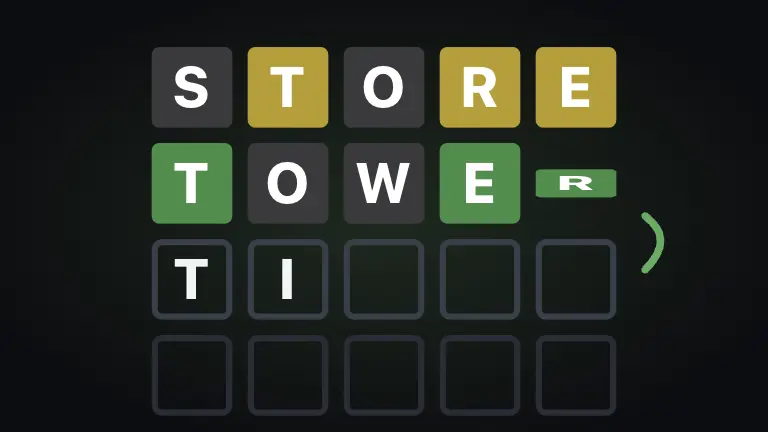
- Five Letters: one secret word a day and six guesses. Start with a word that uses common, different letters, then use every clue: a letter in the wrong spot narrows things down as much as a right one.
- Four Groups: sixteen words, four hidden groups, four mistakes allowed. Look for the group with the trickiest overlap first; the obvious one is often a trap.
- Word Wheel: seven letters, one in the middle, and as many words as you can spell. Climb to Word Wizard by looking for endings like -ED, -ER and -ING.
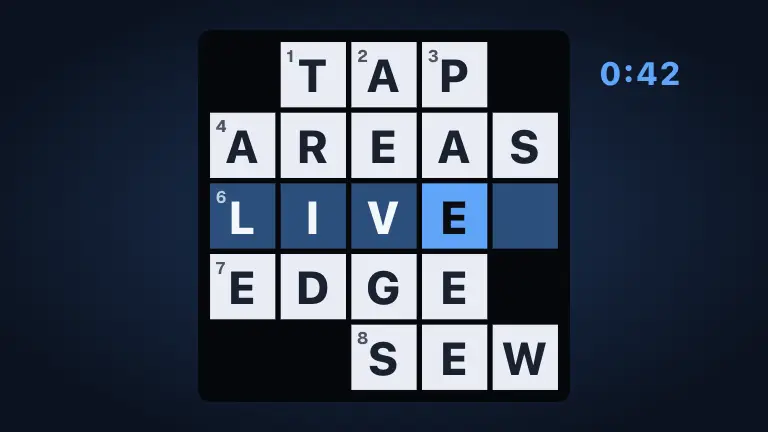
- Mini Cross: a pocket-size crossword with a timer, streaks and every past puzzle in the archive. Usually two or three minutes.
- Threads, Four Sides, Quad Words, Grid Swap and Scramble are more: theme words woven through a grid, twelve letters around a square, four boards at once, a scrambled grid to swap back, and an unscramble with a punchline.
Logic puzzles
Logic puzzles have one answer, reachable by reasoning alone. No guessing, no luck, just the satisfying click of a deduction.
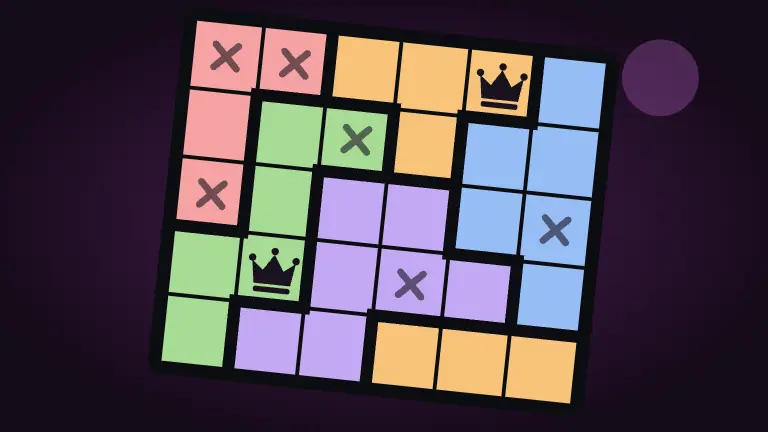

- Queens Court: one queen in every row, column and color region, and no two touching. Start with the smallest color region; it often has only one or two possible cells.
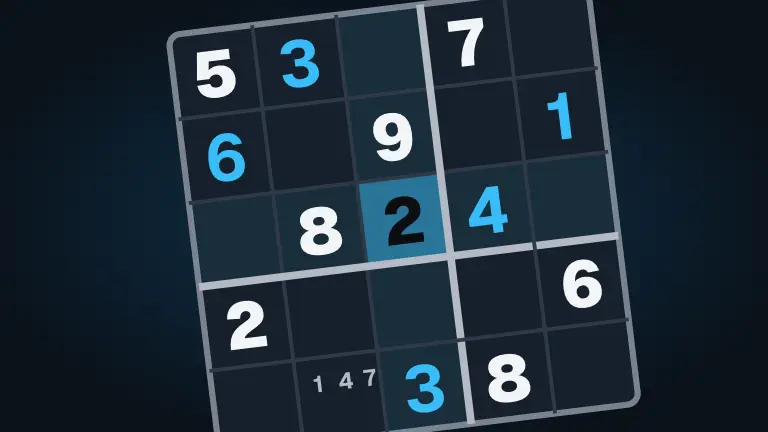
- Sudoku: four difficulties every day, with pencil marks, hints and a clock. Pencil marks are not cheating; they are how hard puzzles get solved.
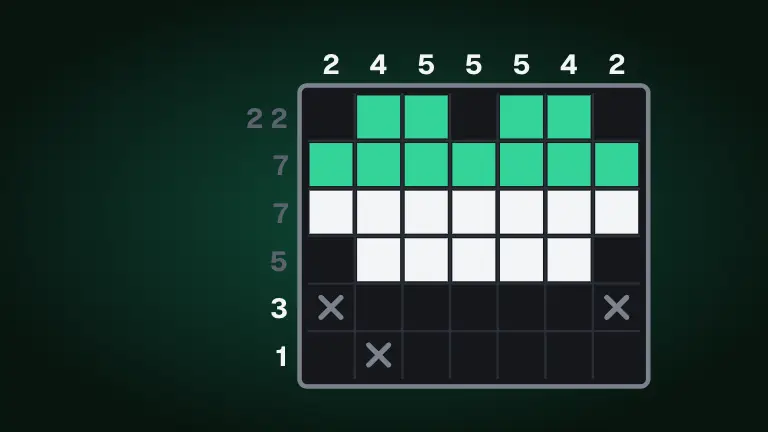
- Nonogram: fill the grid from the number clues and a picture appears. Three sizes a day.
- Whodunit: something went missing. Read the clues, fill in the deduction grid and name the culprit, where and with what.
- Sun & Moon, Bridges, Loop and Number Path are quick grids with simple rules and deep logic. Killer Sudoku, Kakuro and Cage Math add arithmetic.
Trivia and general knowledge
- Daily Ten: ten trivia questions a day, the same for everyone. Beat the clock and your friends.
- Outline: name the country from its outline in six guesses. Each miss tells you how far off, which way and how close.
- Link Ladder: climb a ladder of linked words a letter at a time, alone in the daily or in teams on a TV.
Number and brain training
- Equate: guess the hidden equation in six tries; every guess has to add up. There is a Mini too.
- Brain Gym: five one-minute drills for speed, memory, math and focus, adding up to one daily score.
- Chess Puzzles: find the winning move. A puzzle of the day, three more from easy to hard, and a rated mode that learns your level.
Something different
A few dailies are not puzzles in the usual sense, but they scratch the same itch:
- High Hand: a card roguelite with a new Daily Run every day.
- Sundown Trail: lead five travelers west by covered wagon, with a new Daily Trail.
- Mapwright: everyone draws the same shapes on their own map; the daily survey gives everyone the same draw.
- Stand Tall: tip a stone block across floating platforms and stand it up in the hole.
Build a five-minute routine
The players who keep streaks the longest usually pick three dailies and play them in the same order every day. A routine we like:
- One word game to wake up: Five Letters or Mini Cross.
- One logic puzzle with your coffee: Queens Court on weekdays, a bigger Sudoku or Nonogram at the weekend.
- One trivia round to finish: Daily Ten.
That is about ten minutes, and it never feels like a chore. Each daily keeps its own streak, and there is one more streak across them all; a week in a row earns a freeze that covers a missed day. Still, a routine at the same time each day is the easiest way to keep a streak alive.
Play with friends, apart
Dailies are secretly a social game. Because everyone gets the same puzzle, the Daily tab can show how your friends did today, and sharing your result in a group chat starts a conversation without spoiling the answer. It is one of the easiest ways to stay in touch with friends who live far away; see Games to play with long-distance friends and on a video call for more ideas.
Puzzles on the go
Every daily runs in the browser on a phone, so they fit a commute or a queue, with nothing to install. For more games that fit a short break, see Quick games to play on your phone in five minutes.
Tips for getting better
- Play the archive or practice mode. Most dailies have one, and a few extra puzzles a week build pattern recognition fast.
- Learn one technique at a time. In grid puzzles, look for the cell with the fewest options; in word games, track which letters are ruled out.
- Don't race at first. Timers are fun later; accuracy comes first.
- Check your stats. Seeing your average guesses or solve time fall is half the motivation.